Update: Skyweek rightly pointed out that the sketches are elaborate fakes. An ebook depicting the story will be released this month.
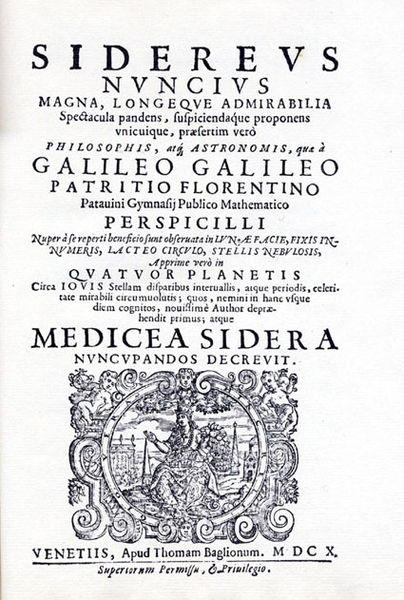
Galileo Galilei (1564-1642) is generally credited to be the first scientist to use an optical telescope for astronomical purposes. In 1609, he made his first own “telescopium” and pointed it to the starry nocturnal sky. Thus, he not only discovered four Jupiter moons but also made an important discovery about our own lunar companion: the moon has a jagged surface and is not a smooth spehere. He presented his findings one year later in his famous book Sidereus Nuncius (“Starry Messenger”), illustrated with various copper engravings. Over 500 copies of the book were printed. It was assumed that the original watercolor paintings of the moon, which served as the original for the engravings, were those preserved in the National Library in Florence, Italy. When scientists from Berlin and Padova now compared these drawings with the engravings, it was clear that they differed in many details. They could not be the original drawings used for the engraved illustrations. (more…)
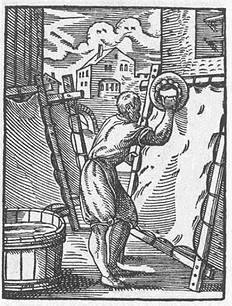 Parchment is made of animal skin, mostly from goat and sheep, which has been dried and scraped under tension. It was the preferred writing support material for manuscripts and maps from around 200 BC until the 16th century, when it was replaced by paper. In the late Middle Ages, town parchment makers (“parchmenters”) had shops in the vicinity of artisans and trade groups. The picture to the left shows a German parchmenter around 1568 [1].
 Oldprints